
North Korean Economy ABC, Part 1: Economic Policy and Its Results in the Kim Il Sung Era
Translated from Korean by AI.
It makes little sense to talk about North Korea without understanding its economy. It is equally absurd to talk about the unification of the two Koreas without understanding the North Korean economy. These days, South Korea's regular broadcast news programs often mention North Korea's economic situation, but what they offer is nothing more than photos and brief reports imported from foreign news outlets. Such superficial photos and reports cannot reveal the true face of the North Korean economy.
Here, I want to examine the North Korean economy from the 1948 liberation to the present, covering roughly 80 years across three generations of North Korean leaders, Kim Il Sung, Kim Jong Il and Kim Jong Un, with a focus on macroeconomics. Macroeconomics is the branch of economics that studies economic phenomena and aggregate movements of a nation as a whole, such as national income, prices, employment, exchange rates and interest rates. Because data on the North Korean economy are scarce, limited and of questionable reliability, it is not possible to know the North Korean economy with real precision, but in this article I will first attempt to estimate and analyze the macroeconomic trends of the North Korean economy with a focus on national income and exchange rates.
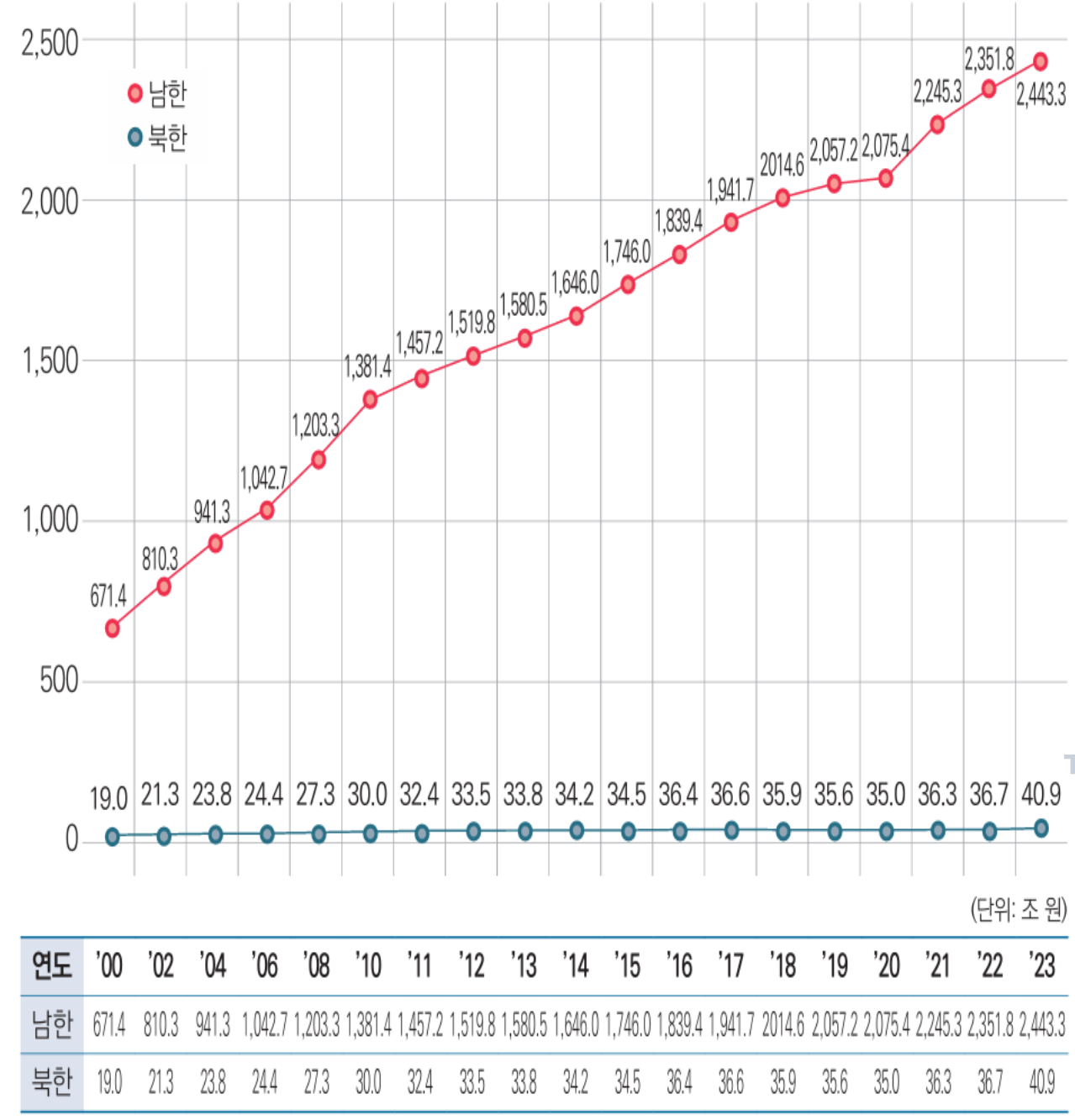
The economic figures cited here are drawn mainly from the research and publications of North Korean economy experts at the Bank of Korea and the Korea Development Institute (KDI). To first summarize the economic policies of the three North Korean leaders from 1948 to 2025: the Kim Il Sung era pursued the economy and national defense in parallel, while the Kim Jong Il era concentrated on defense, that is, nuclear weapons development, rather than the economy. The Kim Jong Un era has adopted a line of pursuing the economy and defense in parallel. Here, I will first look at the economic policies of the Kim Il Sung era and their results.
The Kim Il Sung Era (1948-1994)
The goal was a self-reliant national economy, pursued through a line of developing heavy industry and national defense in parallel, that is, the line of simultaneous economic and defense development. Industrialization in the 1960s was partly successful, but neglect of light industry in the 1970s and a closed economic structure led to stagnation in the late 1980s, marked by technological backwardness and sluggish foreign trade.
Until 1990, North Korea attempted a self-reliant economy built largely on aid from China and Russia, but after the collapse of Russia in 1991, North Korea went through a severe economic crisis from 1991 to 1995. In particular, food shortages led to a prolonged famine known as the "Arduous March," during which countless residents starved to death.
When North Korean President Kim Il Sung died on July 8, 1994, at the age of 82, news reports poured out in South Korea predicting that North Korea would soon collapse. Over the following five years, as many as 2 million and at least 600,000 North Koreans died of starvation due to food shortages. In 1994, South Korea's GNP (Gross Domestic Product, nominal gross national product) was $376.9 billion and North Korea's GNP was $21.2 billion, making the South's roughly 18 times larger than the North's. Most economists agree that per capita income was $9,000 in South Korea and roughly $900-$1,000 in North Korea, meaning that the South's income level at the time was 9 to 10 times that of the North. South Korea's population was 45.42 million, and North Korea's was estimated at 21 to 22 million. In the final years of Kim Il Sung's rule, from 1990 to 1994, North Koreans' preference for the dollar began to grow even though the North Korean won was strong. The official dollar-to-won exchange rate announced by North Korea's Central Bank was 1:4.14, which made the North Korean won nearly 200 times stronger than the South Korean won. However, the exchange rate announced by North Korea's Central Bank ignores the international balance of payments and actual demand in North Korea's real market, so it is merely a nominal figure; in practice, foreign travelers holding dollars do not go to North Korea's Central Bank to exchange them for North Korean won. In 1994, the dollar-to-won exchange rate in the jangmadang (markets), which reflect North Korea's real economy, was between 30 and 50 won. This figure shows that North Koreans' preference for the dollar was 10 times stronger than the Central Bank's rate implied. Dollar preference (dollarization) continued to rise under Kim Jong Il's rule after Kim Il Sung's death, and by 2000, $1 could be exchanged for 200 to 250 North Korean won in the jangmadang. The trend is that dollar preference keeps surging in North Korea.
1994 South and North Korean Macroeconomic Indicators at a Glance

North Korea's economy recorded negative growth for five years, from 1989 to 1994. Despite such a fragile economy, North Korea did not collapse. Rather than the forecasts of South Korea and other countries that North Korea's economy and future seem to have come to a standstill, the North Korean economy is expected to be far more adaptable in responding to external changes. Only by grasping the true nature of the North Korean economy can we produce material that will be useful for the future of the two Koreas.
Comments 0
Please log in to write a comment.