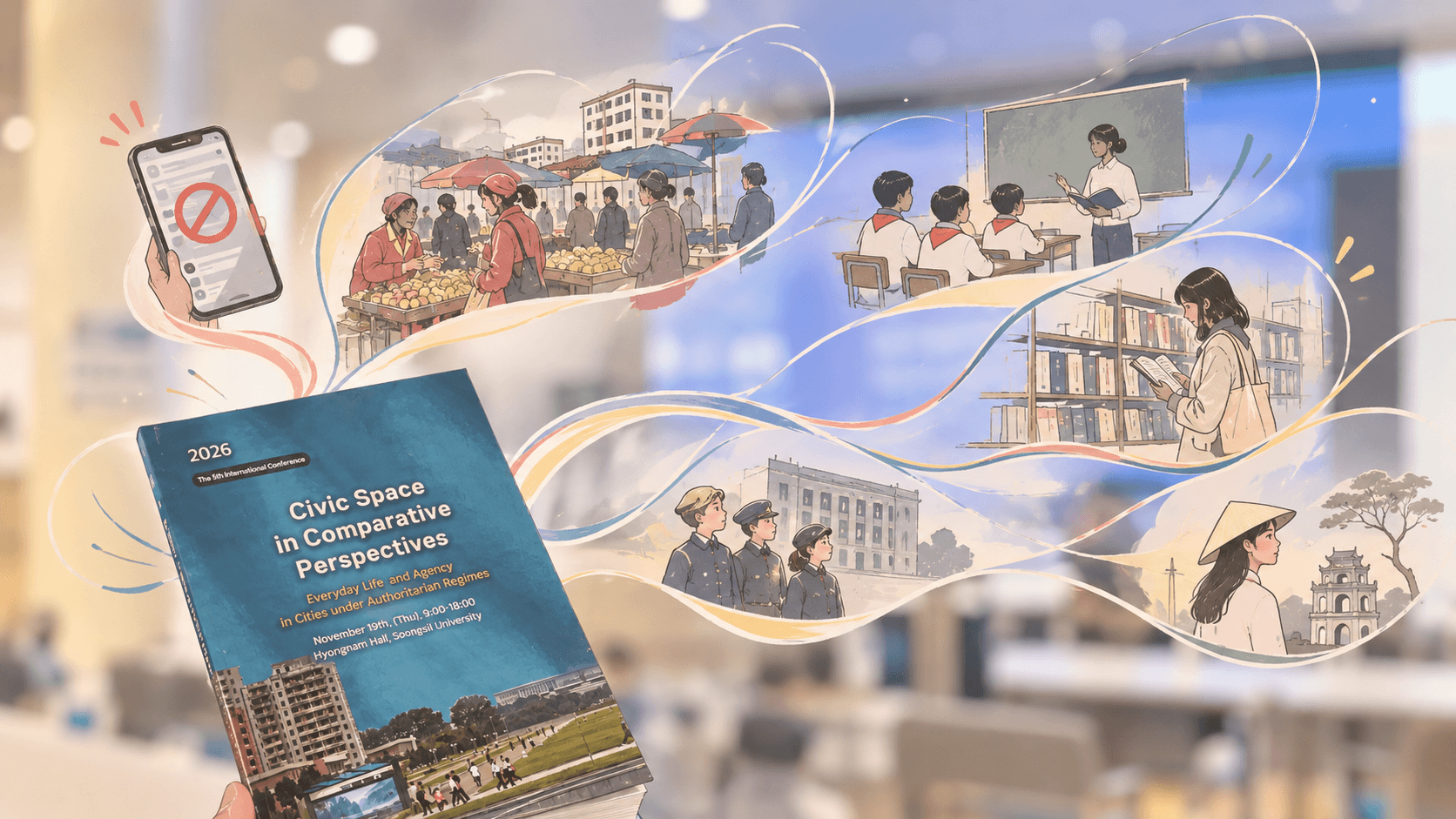
Social Media, Markets, Classrooms and Bookshops: Exploring Civic Space under Authoritarian Regimes
What can social media, a marketplace, a classroom or a bookshop tell us about life under authoritarian rule? That question filled the conference room at Soongsil University in Seoul last Thursday, November 19, 2026.
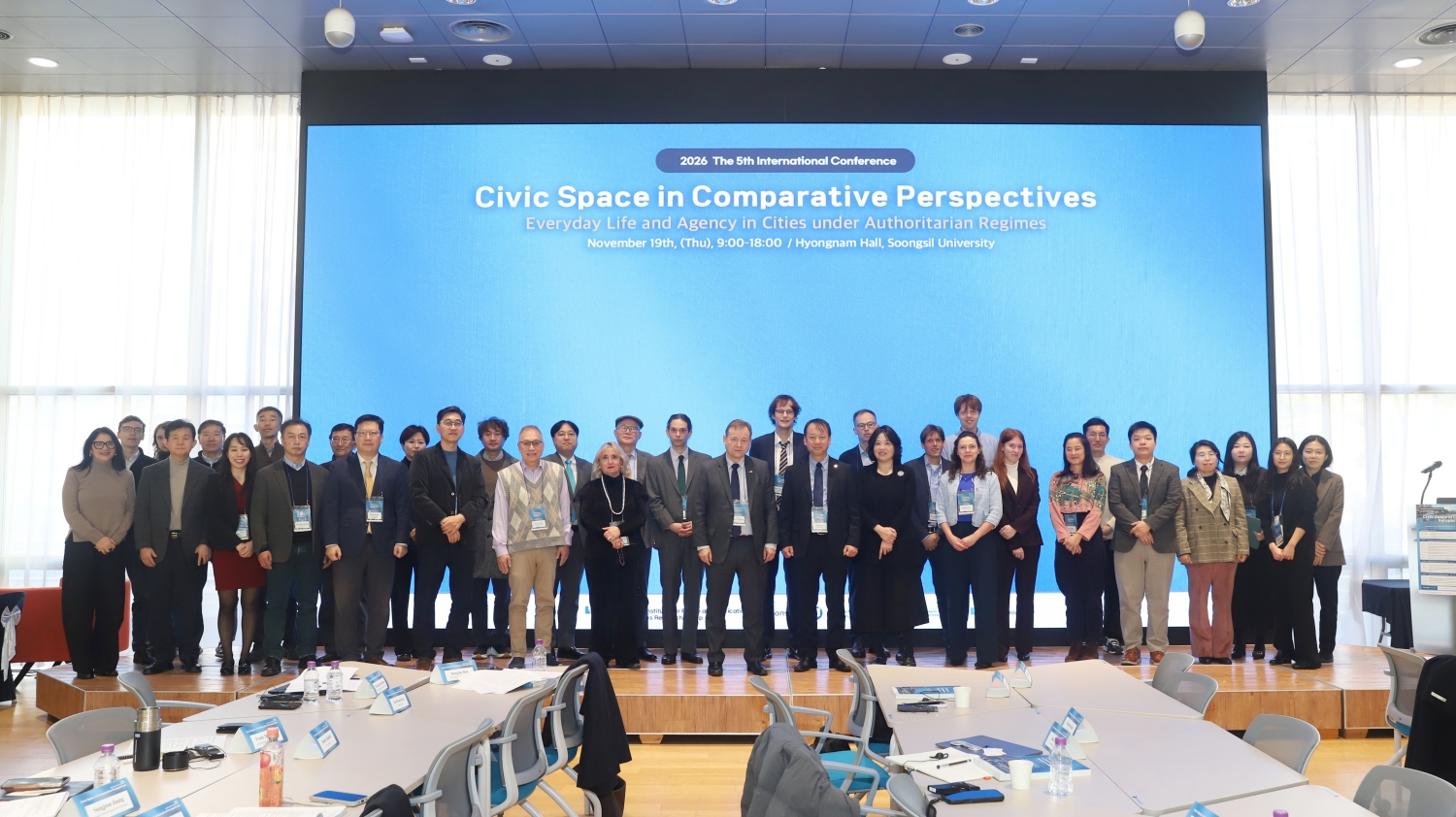
The Soongsil Institute for Peace and Unification held its 5th International Conference, “Civic Space in Comparative Perspectives: Everyday Life and Agency in Cities under Authoritarian Regimes” (see the announcement). Researchers and professionals from different countries compared how people find room to act in places where the state tries to control daily life.
The conversation has deep roots at the institute. Since 2021, it has been running a research project on market-led changes in North Korea’s cities and the lives of their residents.
The program had an opening session with two keynotes, three thematic sessions where researchers and discussants shared their work and thoughts, and a closing roundtable. Special guests and moderators also enriched the day with their experience, questions and comments.
Opening the conversation
The conference started with the welcoming words from Younjai Lee, President of Soongsil University and Georg Wilfried Schmidt, German Ambassador to South Korea.
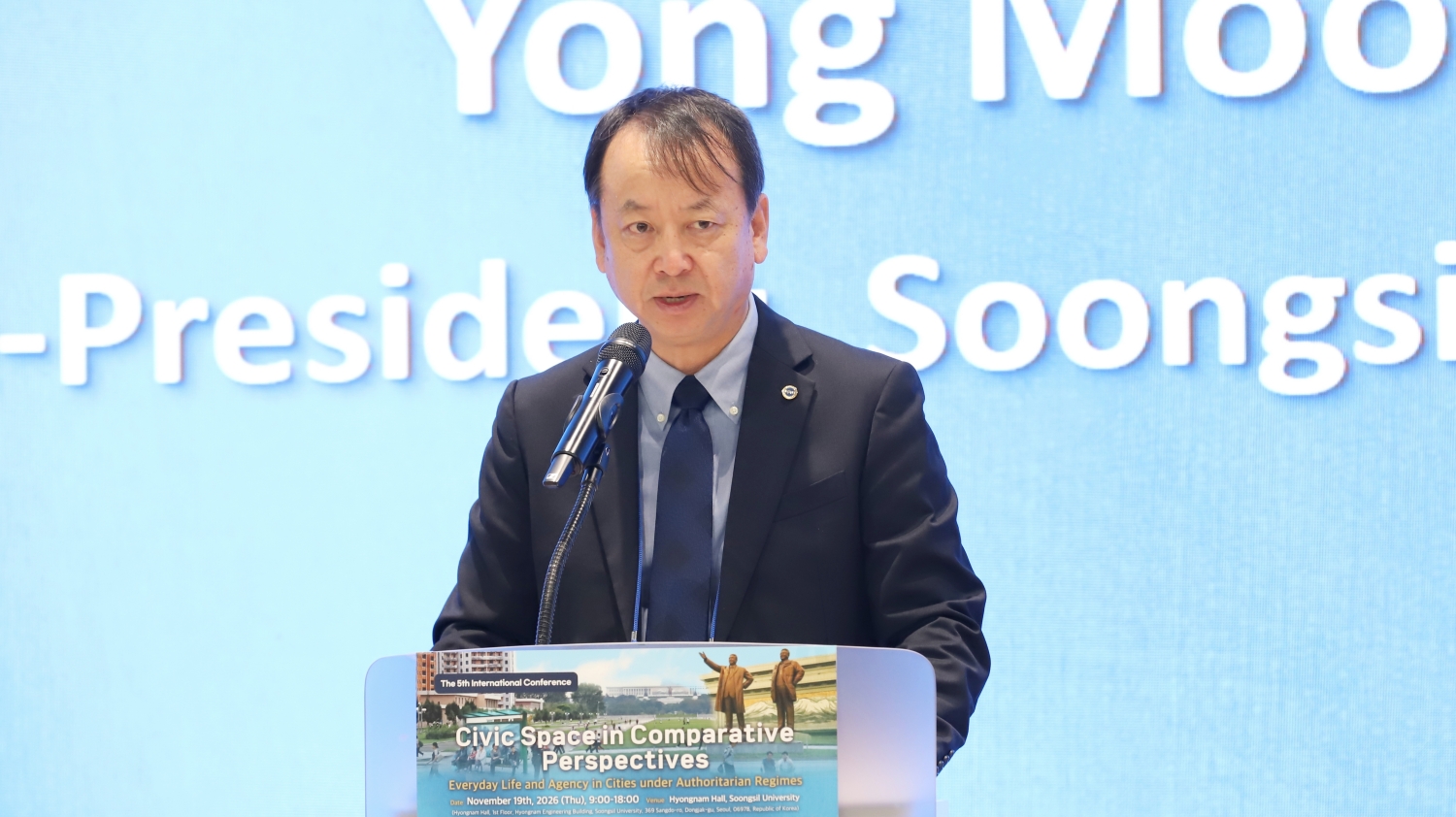
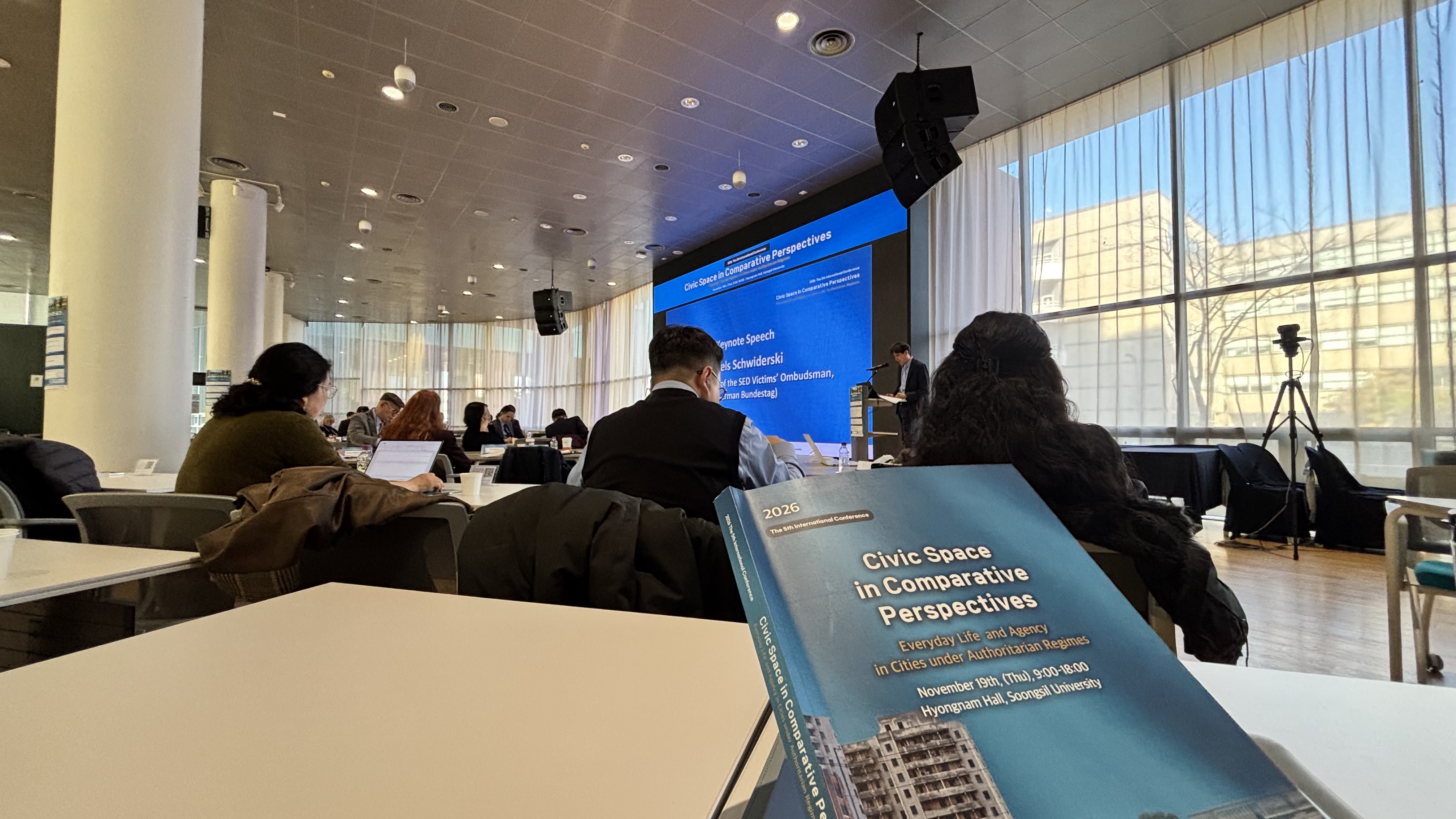
Then, two keynote speakers then set the stage: Sandra Fahy, Professor at Carleton University, whose research includes oral histories of North Korea’s 1990s famine and the state’s human rights abuses, and Niels Schwiderski, head of the office of the SED Victims’ Ombudsman at the German Bundestag, whose work centers on victims of political persecution.
Speaking about repression and resistance in East Germany, Niels Schwiderski said:
The churches were institutions that were largely beyond state control. Within the churches, citizens found a space for action where freedom of expression flourished, and as a result, protest eventually developed. (Niels Schwiderski)
Therefore, there will always be special places, even if they are like small seeds in vast soil, with the potential to grow into something that breaks through authoritarian regimes.
Session 1: Trust, stability and civic space in North Korea
Chaired by Jiyoung Kim, Director of the institute, the first session looked closely at North Korea, one of the most authoritarian regimes of this century.
The session also featured a comment paper by Professor Emeritus Sung-Bae Kim on how journalists’ source networks can support research on closed societies, using evidence from North Korea. Its four presentations each had their own discussant:
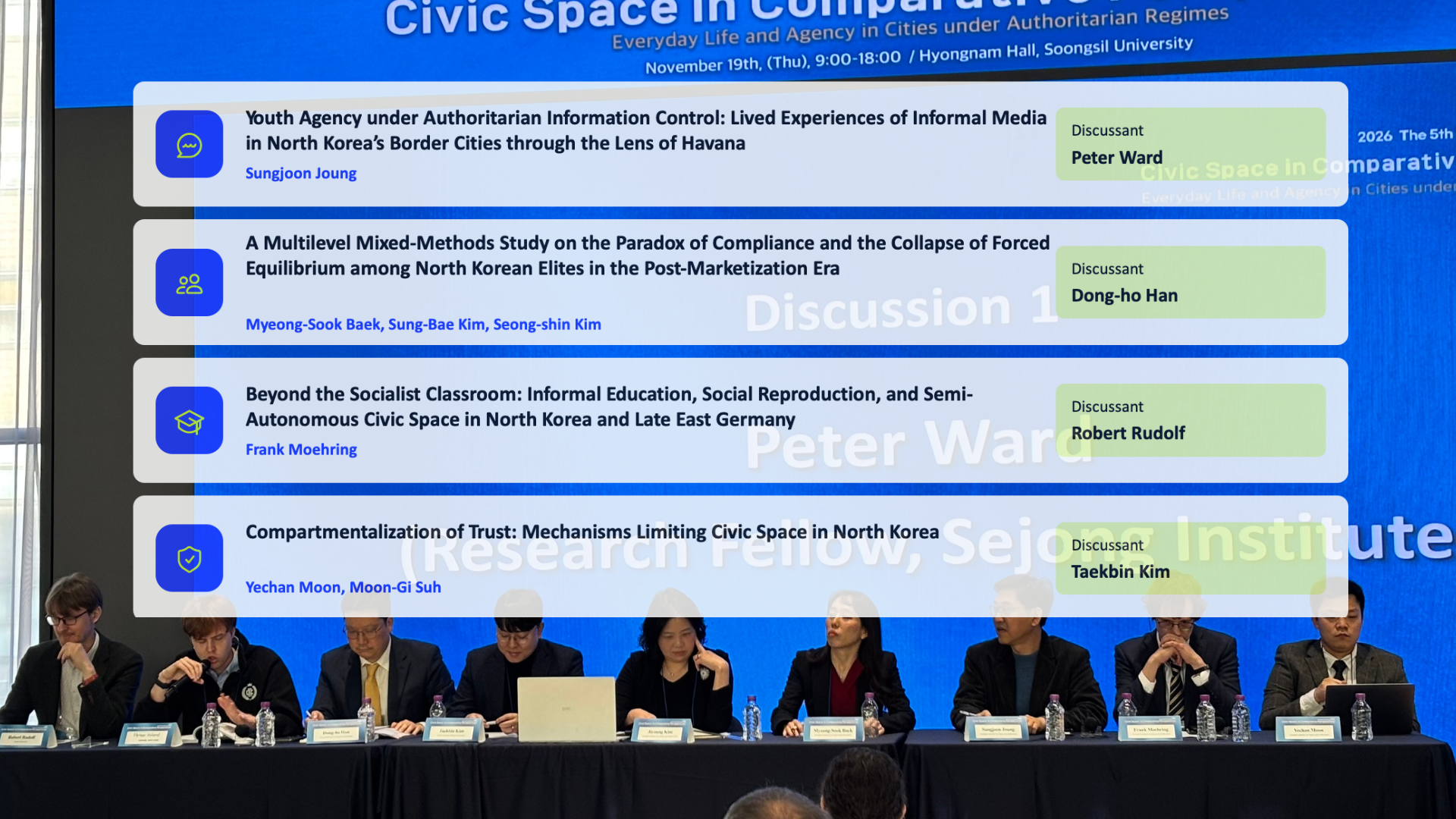
Informal media and young people – Sungjoon Joung
Even under strict censorship, young North Koreans find ways to access foreign movies and other forbidden media through underground networks. This research explores how these networks depend on trust and secrecy, where a friend can be both a source of protection and a potential risk.
Discussant: Peter Ward.
Elites and compliance – Sung-Bae Kim, Myeong-Sook Baek & Seongsin Kim
What happens when a government starts taking more from its own supporters than they can afford to give? This research explores how North Korean economic elites may respond not through open rebellion, but through quietly hiding their wealth and sabotaging the system from within, potentially paralyzing the regime even while its security forces remain strong.
Discussant: Dong-ho Han.
Learning beyond the classroom – Frank Moehring
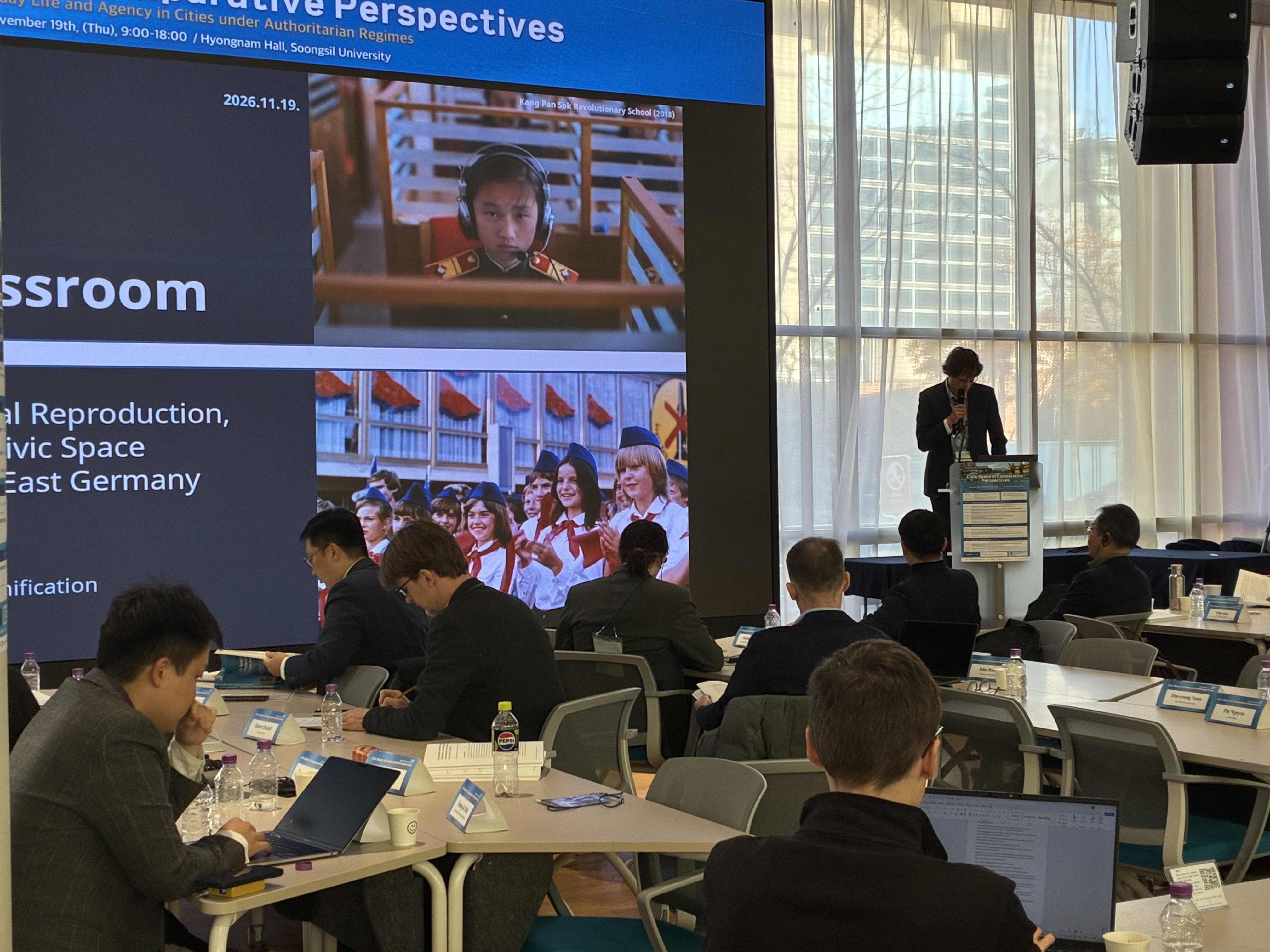
Can a private tutoring session become something bigger than just studying for an exam? Comparing North Korea with late East Germany, this research examines how informal learning can create friendships, independent networks, and opportunities for collective action, while showing why these connections developed into civic engagement in East Berlin but have remained more limited in North Korea.
Discussant: Robert Rudolf.
The limits of trust – Yechan Moon & Moon-Gi Suh
North Koreans increasingly depend on one another to run businesses, borrow money, and survive, but does that mean they trust each other enough to stand together? This research finds that trust often has limits: someone may be a reliable business partner but not necessarily someone with whom you would discuss politics or challenge the authorities.
Discussant: Taekbin Kim.
Session 2: Everyday agency under authoritarianism
With Professor Sandra Fahy as chair, the second session moved from North Korean markets to Vietnam and the South Caucasus. The focus was on what ordinary people do to get by.
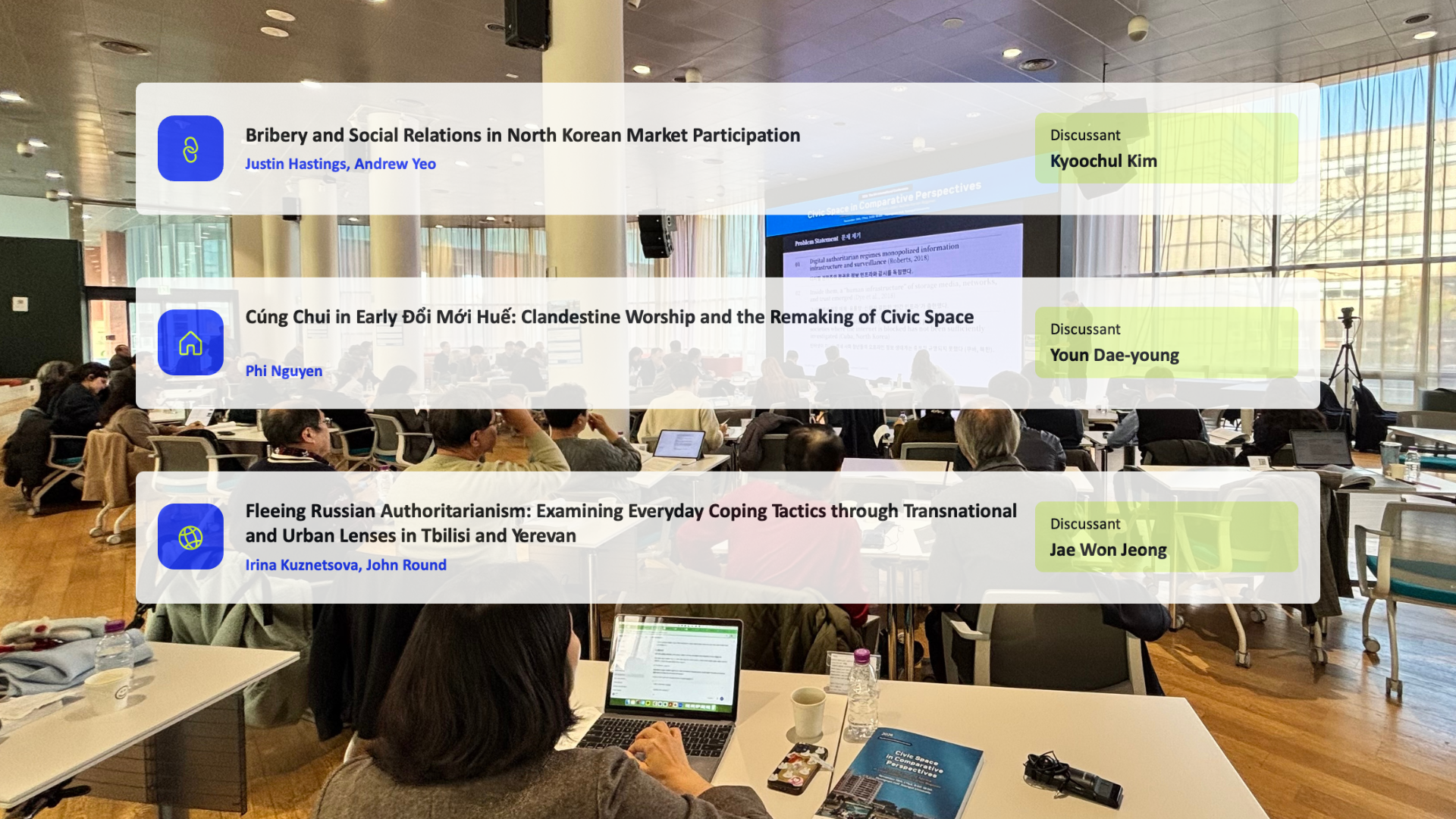
Bribery and Social Relations in North Korean Market Participation – Justin V. Hastings & Andrew Yeo
In North Korea, paying a bribe isn't always seen as corruption; sometimes, it's simply how people get things done and keep their businesses running. Drawing on interviews with market participants, this research reveals how bribery can actually build trust, strengthen relationships between businesspeople and officials, and help everyday markets function in a society where formal institutions offer little support.
Discussant: Kyoochul Kim.
Cúng Chui in Post-war Huế: Clandestine Worship and the Remaking of Civic Space – Phi Nguyen
After the Vietnam War, local religious practices and traditional crafts were banned as the government sought to reshape the country's cultural identity. Through stories of villagers who secretly preserved rituals, rebuilt shrines, and hid traditional crafts from authorities, this research shows how everyday acts of quiet resistance helped communities protect their cultural heritage and maintain their identities across changing political regimes.
Discussant: Youn Dae-young.
Fleeing Russian Authoritarianism– Irina Kuznetsova & John Round
What happens when leaving an authoritarian country does not mean escaping its reach? Based on research with Russians who fled to Tbilisi and Yerevan after the invasion of Ukraine, this study explores how they rebuild their lives while facing surveillance, threats, uncertainty, and sometimes hostility in their new cities.
Discussant: Jae Won Jeong.
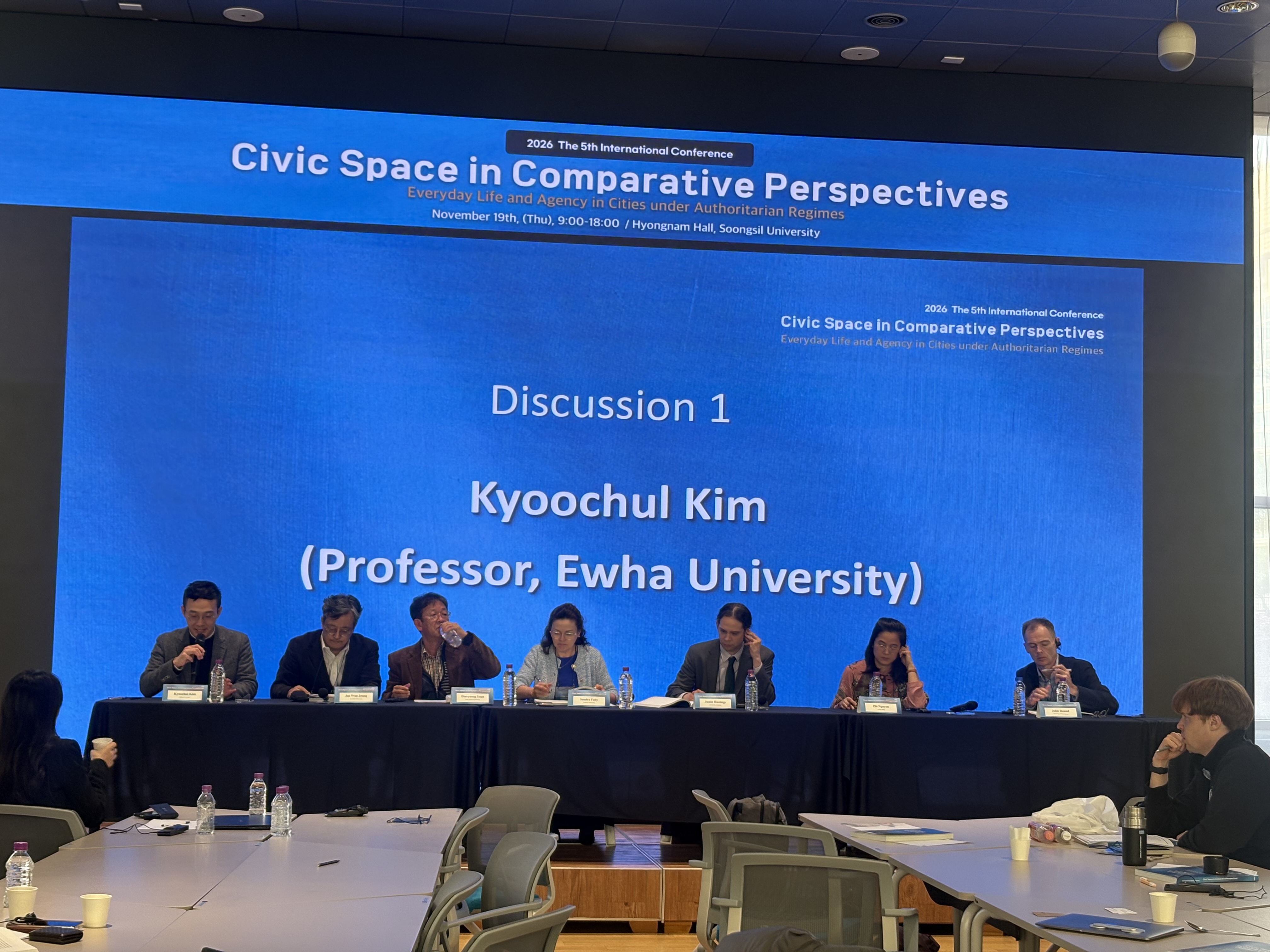
Session 3: Cities as spaces of mediation
The final session, “Urban Mediation and Authoritarian Space,” was chaired by Philo Kim and took the audience to three very different cities.
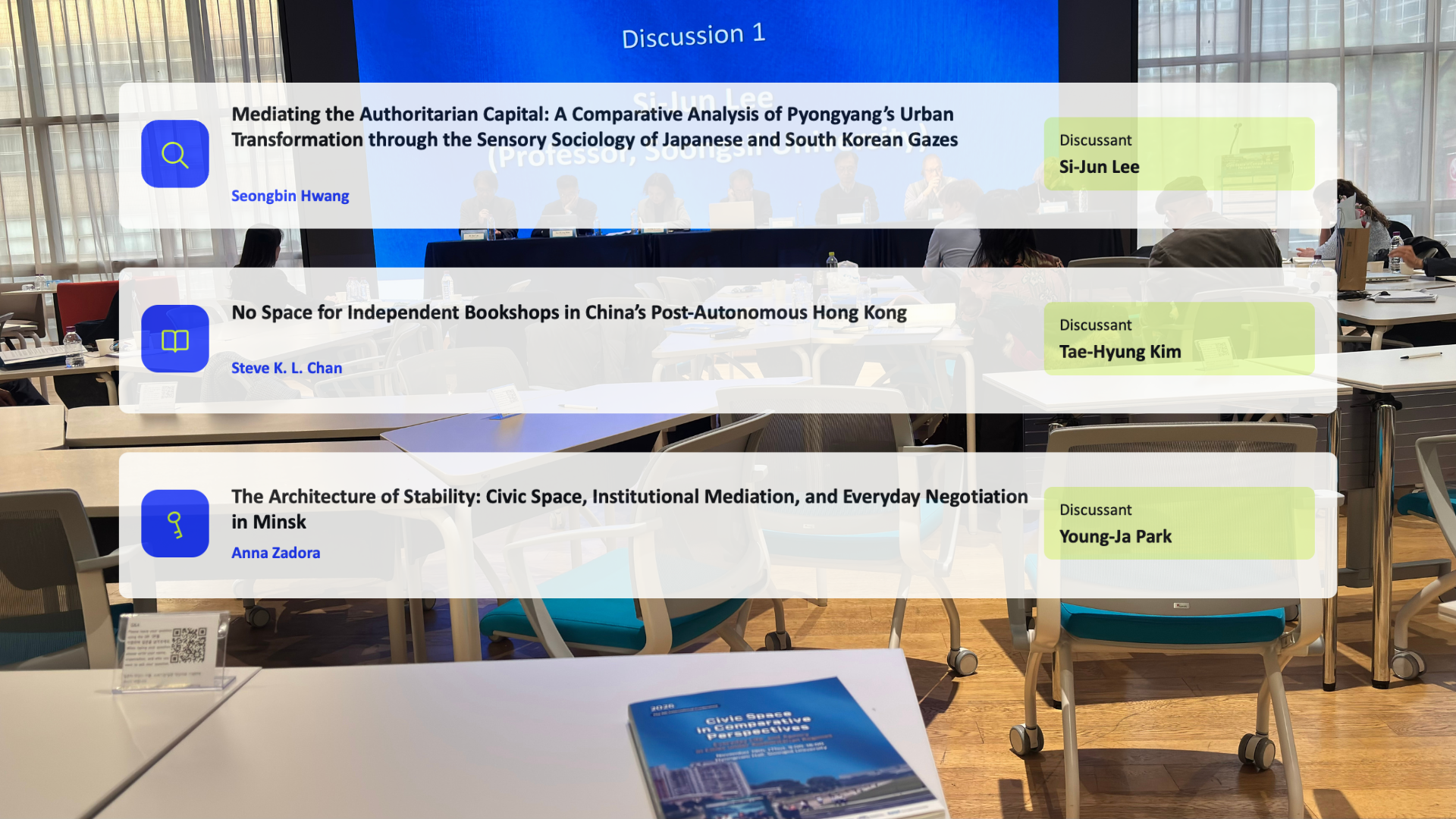
Mediating the Authoritarian Capital – Seongbin Hwang
Can we really understand a city by looking at pictures of it? This research examines how Japanese and South Korean media have portrayed Pyongyang over the decades, showing how the city’s image has shifted from a threatening authoritarian capital to a more romanticized or humanized place, depending on each country's political interests and cultural perspectives.
Discussant: Si-Jun Lee.
No Space for Independent Bookshops in China's Post-Autonomous Hong Kong – Steve K. L. Chan What happens when even a bookstore becomes a politically sensitive place? This research explores how Hong Kong's independent bookshops, once important spaces for reading, discussion, and the exchange of ideas, have been increasingly restricted as China's political control over the city has tightened, particularly following the 2020 National Security Law.
Discussant: Tae-Hyung Kim.
Civic Space, Institutional Mediation, and Everyday Negotiation in Minsk – Anna Zadora
How can an authoritarian government remain stable for decades without controlling every aspect of people's daily lives? Through the case of Minsk, Belarus, this research argues that stability depends not only on repression, but also on everyday compromises: people follow public rules while maintaining some autonomy in private spaces, neighborhoods, schools, and social institutions.
Discussant: Young-Ja Park.
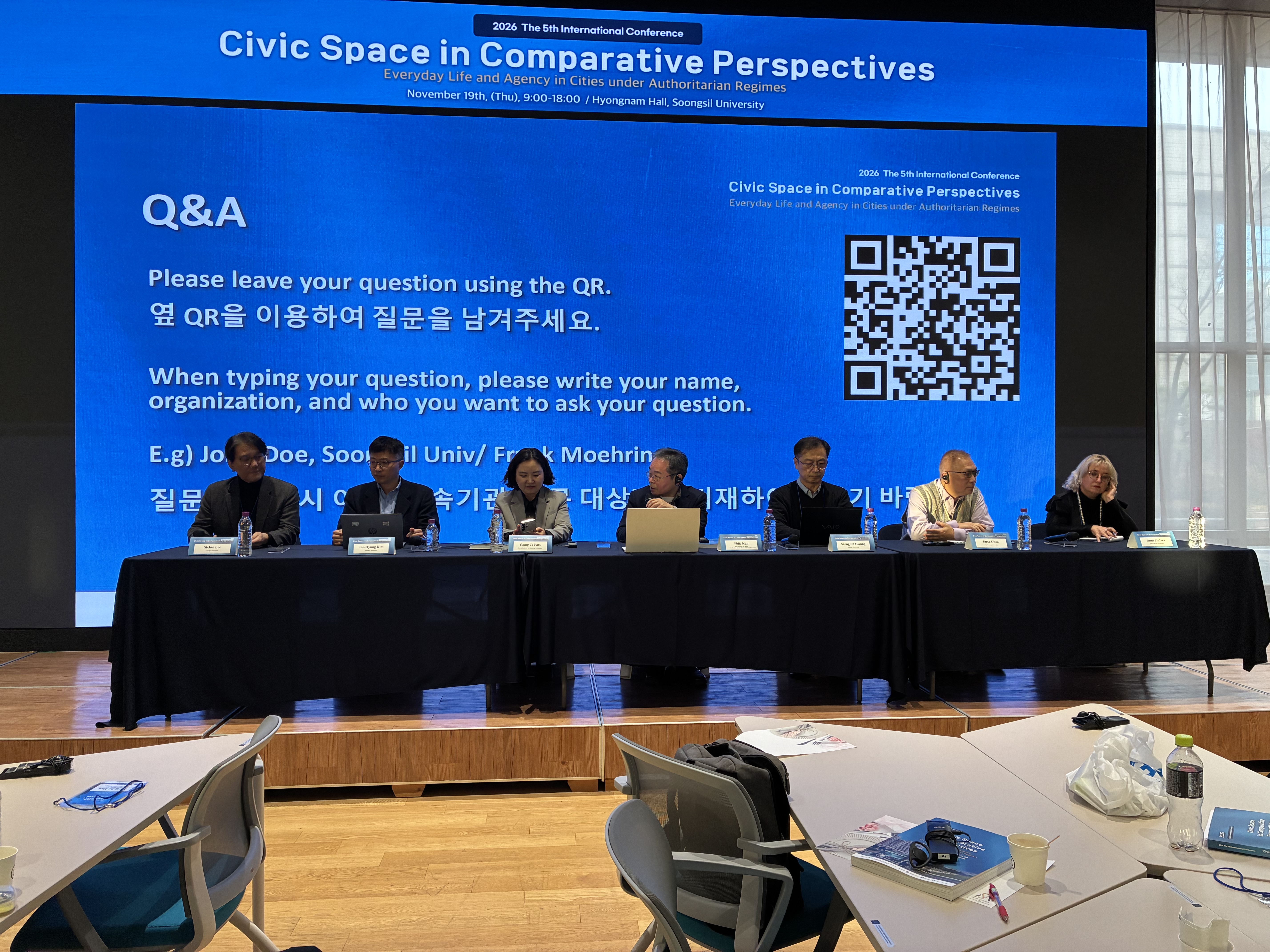
The day closed with a roundtable, which brought the discussion back to a shared question: how can civic spaces grow?
A whole new world opening
Personally, this was a very special experience. Being surrounded by experts and passionate researchers, sharing their findings and interests, was deeply insightful. I heard comparisons I would never have imagined, and it felt like a whole new world opening.
What fascinated me most were the similarities between cities under authoritarian regimes. And what about civic spaces? They can be a market, a school, a bookshop, social media or a social group. Each presenter brought a fresh and unique view of these spaces.
The discussions were just as valuable. Coming from academic and research fields, the discussants offered relevant points of view. They contributed to the presenters’ research and helped the audience think more deeply about each subject.
The university and the organizing team also deserve a special mention. The conference structure was excellent, comfortable and very well organized. Every participant also received a book compiling the research papers and speeches, so we could follow along and keep it. Live translation between Korean and English meant no one was left out, overwhelmed or lost. The audience could enjoy each speech giving their full attention without anything to worry about.
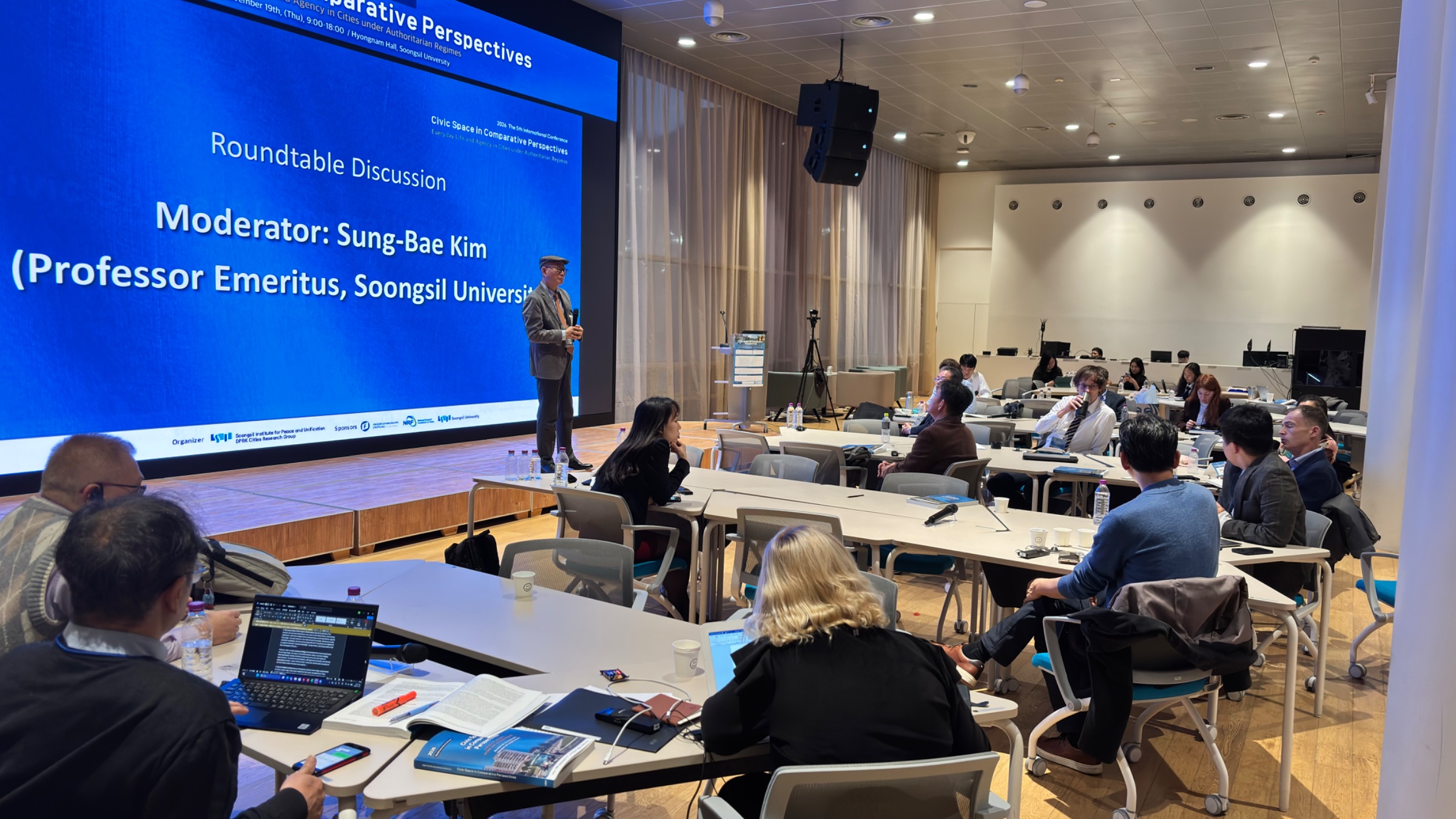
Conclusion: small seeds of change
After a day of so many new and interesting information, the conference ended with a dynamic and lively roundtable where everyone had a chance to share their final thoughts, questions and impressions.
But what to do from now on? How to turn all this knowledge into action and contribute to the creation and sustainability of these civic spaces?
During the final moments, Dr. Joung, Research Fellow at the Soongsil Institute for Peace and Unification, pointed to the way forward:
There is a possibility to grow civic spaces because they are always moving and changing. All the spaces are made of people, and especially young people are keen to change their lives. Our role is to empower them.
A conference built on research and shared academic knowledge ended with a practical call: to turn that knowledge into concrete action, starting with the people who make these spaces.
Comments 0
Please log in to write a comment.