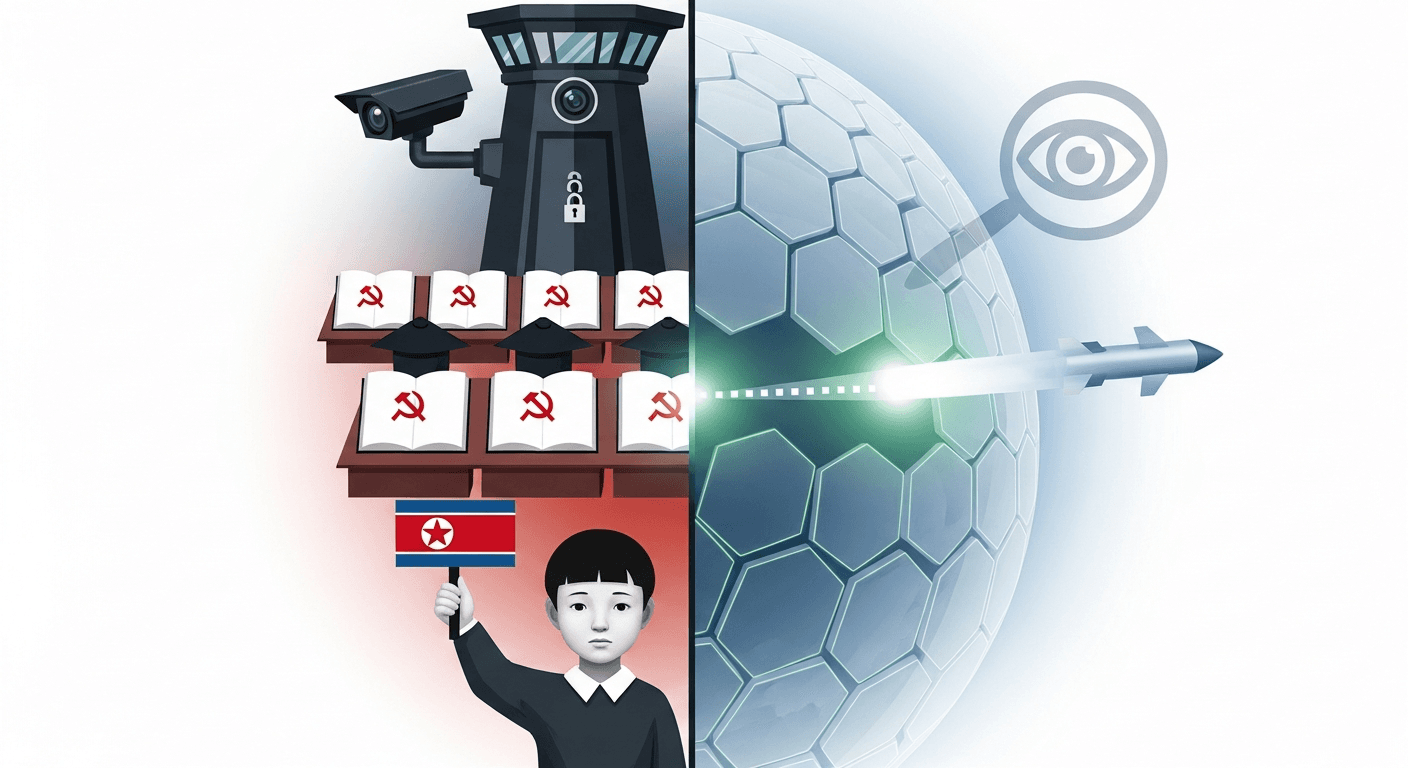
This report cross-analyzes North Korea's recent strategies for strengthening internal control and managing its external image, alongside South Korea's corresponding efforts to enhance its defense capabilities. Notably, North Korea's renaming of the State Security Ministry to the State Information Bureau and the enactment of the Education Support Law indicate moves to consolidate the regime, while Kim Ju-ae's public appearances are seen as visual propaganda for generational power succession. Concurrently, South Korea is bolstering its defense posture by accelerating the deployment of the Long-range Artillery Interception System (LAMD) and confirming the introduction of SM-3 missiles. The domestic political controversy surrounding the Ssangbangul North Korea remittance case further complicates the situation on the Korean Peninsula.
Overview
This report comprehensively analyzes North Korea's recent strategies for strengthening internal control and managing its external image, alongside South Korea's corresponding efforts to enhance its defense capabilities, and the domestic political controversies related to inter-Korean affairs in South Korea. North Korea is observed to be consolidating its internal system through measures such as renaming the State Security Ministry and enacting the Education Support Law, while also sending visual messages about generational power succession through Kim Ju-ae's public activities. In response, South Korea is strengthening its defense posture by accelerating the deployment of the Long-range Artillery Interception System (LAMD) and confirming the introduction of SM-3 missiles. Simultaneously, the domestic political dispute surrounding the Ssangbangul North Korea remittance case acts as a factor that complicates the situation on the Korean Peninsula.
Background and Context
North Korea is analyzed to be employing diverse strategies for regime maintenance and reinforcement in response to internal and external environmental changes. In particular, the renaming of internal control agencies and the institutionalization of resource mobilization laws imply dual objectives of securing regime stability and distributing economic burdens. This aligns with the 'controlled opening' and 'strengthening internal control' trends of North Korea analyzed in previous LAIA reports. South Korea, in turn, is pursuing both independent defense capability enhancement and the maintenance of deterrence based on the ROK-US alliance to counter North Korea's escalating threats. Meanwhile, domestic political controversies in South Korea related to North Korea act as complex variables in the implementation of North Korea policy, potentially increasing uncertainty in the security environment of the Korean Peninsula.
Current Situation Analysis
North Korea has recently shown changes in its internal control and regime propaganda strategies. The renaming of the State Security Ministry to the 'State Information Bureau' and local security agencies to 'Information Departments' is analyzed as an attempt to project a normal state image and strengthen intelligence functions. However, residents reportedly feel fear, associating it with South Korea's past Agency for National Security Planning.8 This suggests that regime protection and internal control remain core functions. Furthermore, an analysis of the 'Education Support Law'13 indicates that by institutionalizing support for the education sector and effectively obligating institutions, enterprises, and citizens to contribute funds, the central government intends to shift the burden of education investment to local entities and residents. Kim Ju-ae's fashion evolution is analyzed not merely as a sign of growth but as a meticulously planned 'visual political propaganda' by the Workers' Party Propaganda and Agitation Department, serving as a strategic tool to hint at future power succession.6 At the Sinpo South Shipyard, the repurposing of a coastal cargo ship near the launch rails used for submarine construction has been observed, though its purpose remains unclear.3 This appears to be part of the Sinpo complex's modernization and expansion efforts, but the overall construction pace is observed to be slow.3
North Korea's Internal Control Apparatus Changes
- Previous: Ministry of State Security, Provincial/City/County Security Departments, Security Instructors
- Changed: State Information Bureau, Provincial/City/County Information Departments, Information Instructors
- Analysis: Ostensibly to project a normal state image and strengthen intelligence functions, but in reality, maintaining regime protection and internal control functions.8
South Korea is accelerating its defense buildup in response to North Korean threats. The government plans to deploy the Long-range Artillery Interception System (LAMD), dubbed the 'Korean Iron Dome,' two years ahead of schedule, starting in 2029, to counter North Korea's multiple rocket launcher threats.1, 14 The LAMD, with a total project cost of 842 billion won, is a short-range, low-altitude air defense weapon aimed at defending against simultaneous incoming North Korean long-range artillery.1 Additionally, military authorities have finalized plans to procure SM-3 missiles for high-altitude interception of North Korean ballistic missiles.14 President Lee Jae Myung informed a delegation of U.S. lawmakers that South Korea intends to take primary responsibility for defense against North Korea and strengthen 'self-reliant defense,' emphasizing that South Korea should lead the defense of the Korean Peninsula.10
| Defense Enhancement Element | Description | Deployment/Introduction Timeline |
|---|---|---|
| Long-range Artillery Interception System (LAMD) | Korean Iron Dome, short-range, low-altitude air defense weapon | 2029 (2 years ahead of schedule)1, 14 |
| Standard Missile-3 (SM-3) | High-altitude interception of North Korean ballistic missiles | Procurement plan finalized14 |
Meanwhile, within South Korea, the political controversy surrounding the 'Ssangbangul North Korea remittance' case has intensified, with the 'allegations of coerced testimony' being transferred to a second special prosecutor.2 During a parliamentary audit, ruling and opposition parties clashed fiercely over the North Korea remittance issue, with claims ranging from specific individuals orchestrating the scheme to the current president's direct involvement.4, 5, 12 U.S. Under Secretary of State for Public Diplomacy, Sarah Rogers, cited her meeting with North Korean defectors as the most memorable moment of her visit to South Korea, emphasizing her stance against 'censorship.'15 This can be interpreted as an indirect expression of concern regarding amendments to South Korea's Act on Promotion of Information and Communications Network Utilization and Information Protection.15
"South Korean President Lee Jae Myung told a delegation of U.S. lawmakers that Seoul seeks to take primary responsibility for defense against North Korea, outlining his administration’s commitment to 'greater military self-reliance.' He emphasized that this aligns with the U.S. government’s direction and that the defense of the Korean Peninsula should be handled by South Korea."10
Outlook and Implications
North Korea is projected to continue its efforts to consolidate its internal system and enhance resource mobilization efficiency. The renaming to the State Information Bureau is interpreted as a dual strategy: pursuing a normal state image externally while maintaining the control of its intelligence agencies internally. The messaging of power succession through Kim Ju-ae is seen as an attempt to demonstrate the long-term stability of Kim Jong Un's regime both domestically and internationally. South Korea's defense buildup is expected to contribute to strengthening practical deterrence against North Korea's nuclear and missile threats. However, coupled with North Korea's asymmetric force buildup, the possibility of an intensified arms race on the Korean Peninsula cannot be ruled out. The domestic political controversy surrounding the Ssangbangul North Korea remittance case could act as a political burden in future North Korea policy implementation, potentially hindering the flexibility of inter-Korean relations.
Recommendations
Relevant international organizations and government agencies should consider the following policies:
- Strengthen Monitoring of North Korea's Internal Changes: It is necessary to closely monitor the actual changes in the role of North Korea's State Information Bureau and the potential increase in burden on residents due to the implementation of the 'Education Support Law,' and to raise international awareness of potential human rights violations.
- Diplomatic Efforts Linked to South Korea's Defense Buildup: Alongside South Korea's efforts to strengthen self-reliant defense, sustained diplomatic efforts for denuclearization and tension reduction on the Korean Peninsula, based on the ROK-US alliance, are required. Maintaining transparent communication channels with neighboring countries is crucial to prevent the introduction of LAMD and SM-3 from leading to an regional arms race.
- Enhance Transparency and Accountability in North Korea Remittances: The South Korean government needs to ensure transparency in financial flows related to inter-Korean exchanges and strengthen relevant laws and institutional mechanisms to enhance accountability, preventing recurrence of suspicions like the Ssangbangul North Korea remittance case.
- Expand DMZ Ecosystem Preservation Cooperation: In conjunction with the DMZ ecosystem preservation project in Gangwon Province,9 it is necessary to explore possibilities for non-political exchanges and cooperation between the two Koreas and continuously research long-term peaceful utilization plans for the DMZ.
- Chosun Ilbo, "North's Long-range Artillery Interception 'Korean Iron Dome' to be Deployed Early in 2029", April 3, 2024
- Chosun Ilbo, "Prosecution Transfers Ssangbangul North Korea Remittance 'Coerced Testimony Allegations' to Special Prosecutor", April 3, 2024
- 38 North, "Sinpo South Shipyard: Cargo Ship Repurposing Spotted... Purpose Unclear", April 3, 2024
- Yonhap News, "'North Korea Remittance' Clash in Parliamentary Audit… Ruling and Opposition Parties Intensify Debate", April 3, 2024
- Yonhap News, "Ruling and Opposition Parties Clash Fiercely Over 'North Korea Remittance' Allegations in Parliamentary Audit", April 3, 2024
- BBC Korea, "Kim Ju-ae's Fashion, Visual Tool for North Korea's Next-Generation Power Propaganda", April 3, 2024
- Yonhap News, "'April Spring Friendship Art Festival' Opens to Commemorate Kim Il Sung's Birthday", April 3, 2024
- DailyNK, "North Korea's Ministry of State Security Renamed 'State Information Bureau'... Residents 'Fearful, Reminiscent of ANSP'", April 3, 2024
- Yonhap News, "Gangwon Inje, Cheorwon, Yanggu Selected for 2026 DMZ Ecosystem Preservation Project", April 3, 2024
- NK News, "President Lee Jae Myung Emphasizes 'Self-Reliant Defense Against North Korea' to US Congressional Delegation", April 3, 2024
- NK News, "Imjin River Body, Investigation into North Korean Origin Underway", April 3, 2024
- Yonhap News, "'North Korea Remittance' Clash in Parliamentary Audit… Ruling and Opposition Parties Debate Responsibility", April 3, 2024
- DailyNK, "North Korea's 'Education Support Law' Full Text Obtained… Concerns Over Burden Shifted to Residents", April 3, 2024
- Chosun Ilbo, "Military Confirms SM-3 Missile Introduction and Early Deployment of Korean Iron Dome", April 3, 2024
- Chosun Ilbo, "US Under Secretary of State: 'Meeting with Defectors Most Memorable… Against Censorship'", April 3, 2024
References
- South Korea to Deploy 'Korean Iron Dome' Against North's Artillery by 2029, Two Years Early — 조선일보
- Prosecution Transfers Ssangbangul N. Korea Remittance 'Statement Manipulation' Case to Special Prosecutor — 조선일보
- Unusual Ship Repurposing at North Korea's Sinpho South Shipyard Raises Questions — 38 North
- Ruling and Opposition Parties Clash Over North Korea Remittances at Parliamentary Inquiry — 연합뉴스
- Ruling, Opposition Parties Clash Over North Korea Remittance Allegations in Parliamentary Probe — 연합뉴스
- Kim Ju-ae's Fashion: A Visual Propaganda for North Korea's Next-Generation Leadership — BBC 코리아
- North Korea Opens 34th April Spring Friendship Art Festival for Kim Il Sung's Birthday — 연합뉴스
- North Korea Renames State Security Ministry to State Intelligence Bureau; Residents Fearful — DailyNK
- Gangwon's Inje, Cheorwon, Yanggu Selected for 2026 DMZ Ecosystem Conservation Project — 연합뉴스
- S. Korea's Lee Tells US Senators Seoul to Lead North Korea Defense with Self-Reliance — NK News
- ROK Police Investigate Body Washed Ashore Near Border for North Korea Origin — NK News
- Parties Clash Over North Korea Remittance During Parliamentary Inquiry — 연합뉴스
- North Korea's New 'Education Sponsorship Law' Shifts Funding Burden to Citizens — DailyNK
- S. Korea Confirms SM-3 Missile Acquisition, Accelerates Korean Iron Dome Deployment — 조선일보
- US Under Secretary Rogers: Defector Meeting Most Memorable, Opposes Censorship — 조선일보
Comments (0)
Please log in to write a comment.