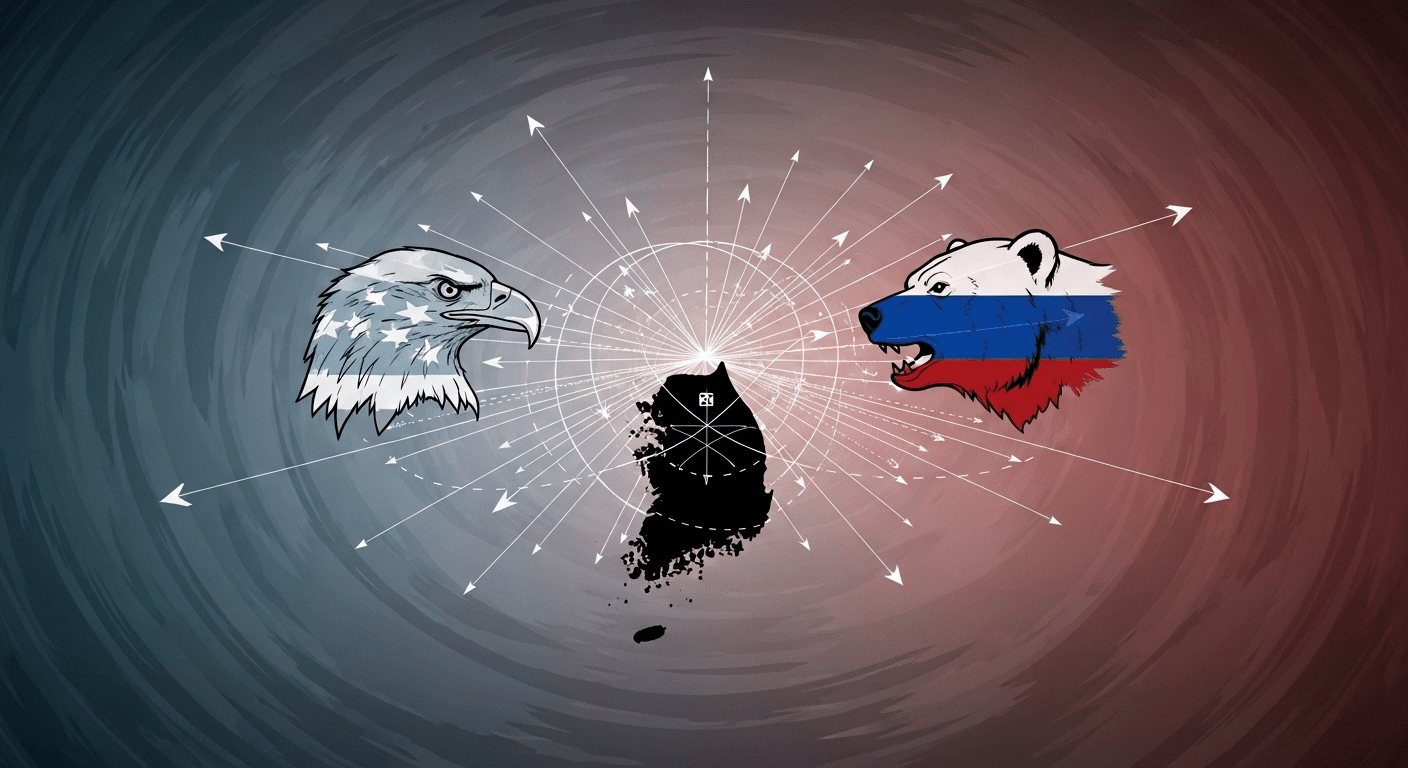
This report cross-analyzes recent trends in the ROK-US information sharing controversy regarding North Korea and the deepening rapprochement between North Korea and Russia. The differing perceptions between the ROK and US on North Korean nuclear facilities, Russia's refusal to screen a North Korean defector film, and increased high-level exchanges and flights between Pyongyang and Moscow are identified as key factors complicating the Korean Peninsula's security environment. These changes escalate regional geopolitical risks and offer significant implications for South Korea's diplomatic and security strategies.
Overview
This report cross-analyzes two major trends shaping the recent security environment on the Korean Peninsula: the controversy surrounding ROK-US information sharing on North Korea and the deepening rapprochement between North Korea and Russia. The differing perceptions between the ROK and US regarding North Korean nuclear facilities, leading to an information sharing restriction controversy, raises questions about the trust within the ROK-US alliance and its joint response system to North Korea. Simultaneously, increased high-level exchanges and flights, along with cultural cooperation between Russia and North Korea, are seen as escalating regional geopolitical risks and posing challenges to international efforts to sanction North Korea. These multilayered changes complicate the security environment on the Korean Peninsula, providing significant implications for South Korea's diplomatic and security strategies.
Background and Context
The ROK-US alliance serves as a critical pillar in responding to North Korea's nuclear and missile threats, with information sharing being an essential component for the alliance's effective operation. North Korea's advancement of its nuclear capabilities continues to pose a threat to the security of the Korean Peninsula and the wider region, making accurate information sharing and joint responses a top priority for the alliance. Meanwhile, while Russia and North Korea have historically maintained friendly relations, their strategic necessity has recently intensified due to Russia facing international sanctions following the Russia-Ukraine war and North Korea's isolation. This has accelerated the rapprochement between the two nations. Against this backdrop, the ROK-US information sharing controversy and the deepening ROK-Russia relationship are noted as factors that could significantly impact the security landscape of the Korean Peninsula.
Current Situation Analysis
A controversy regarding restrictions on ROK-US information sharing on North Korea recently emerged following remarks by Unification Minister Jeong Dong-young concerning North Korea's uranium enrichment facilities. National Security Advisor Wi Sung-lac effectively acknowledged that the ROK-US relationship is in an 'abnormal' state and stated that discussions are underway with the United States to promptly return to a normal state of cooperation3,7. The Blue House described this as 'a slight difference in perception' between the ROK and US, stating that both countries are in close communication to resolve the issue7. Jeong Yeon-doo, South Korea's chief nuclear envoy, is expected to meet with senior US diplomatic officials in Washington to discuss the North Korean nuclear issue and information sharing methods6. This series of events indicates that disagreements have arisen within the ROK-US alliance regarding the assessment and sharing of intelligence on North Korea, and efforts are underway to restore alliance trust.
Concurrently, the rapprochement between North Korea and Russia appears to be deepening. The visit by Russian Interior Minister Vladimir Kolokoltsev to North Korea, where he toured the 'Victorious Fatherland Liberation War Museum,' is analyzed as part of high-level exchanges symbolizing military and political closeness between the two countries10. Furthermore, the increased use of North Korean airspace by Russian aircraft, including military and police jets landing in Pyongyang and the first direct commercial flight from Moscow to Wonsan, can be seen as concrete signs of expanding cooperation between the two nations11. From a cultural perspective, the Russian government's refusal to screen the film 'Hana Korea,' which depicts a North Korean defector's settlement in South Korea, just one week before its scheduled release, can be interpreted as a friendly gesture towards the North Korean regime8.
Comparison of ROK-US Information Sharing Controversy and DPRK-Russia Rapprochement
| Category | ROK-US Information Sharing Controversy | DPRK-Russia Rapprochement |
|---|---|---|
| Key Issue | Perception differences on DPRK nuclear facilities; information sharing restrictions | High-level exchanges, military/political cooperation, increased air traffic |
| Impact | Affects ROK-US alliance trust and joint response system to DPRK | Escalates regional military tensions, challenges international sanctions on DPRK |
| Response Efforts | Pursuit of normalization through high-level consultations and communication | Friendly gestures such as Russia's refusal to screen DPRK defector film |
National Security Advisor Wi Sung-lac stated regarding the US 'restriction on information sharing with North Korea' controversy, "I believe we should promptly return to a normal state of cooperation, and we are discussing this with the United States in that direction"3.
Outlook and Implications
The ROK-US information sharing controversy is likely to be normalized through communication and consultation between high-level officials from both countries, despite potential short-term impacts on alliance trust. However, this incident is expected to serve as an opportunity to reconfirm the importance of intelligence assessment and sharing regarding North Korea's nuclear threat, and to secure transparency and promptness in alliance communication channels. Meanwhile, the deepening rapprochement between North Korea and Russia is anticipated to act as a new geopolitical variable in the Korean Peninsula's security environment. This could escalate regional military tensions and challenge the international community's efforts to implement sanctions on North Korea based on UN Security Council resolutions. South Korea needs to respond to these multilayered security environment changes by further strengthening the ROK-US alliance and seeking international cooperation through multilateral diplomacy to address the DPRK-Russia rapprochement.
Recommendations
- The South Korean government should transparently and promptly restore ROK-US information sharing channels on North Korea and rebuild alliance trust through regular high-level consultations. Consideration should be given to establishing a joint mechanism to maintain consistency in intelligence assessment regarding North Korean nuclear facilities.
- The international community should seek common response measures to the strengthening military and economic cooperation between North Korea and Russia, and intensify monitoring and sanction efforts to ensure the implementation of UN Security Council resolutions. Close scrutiny of Russia's potential assistance in evading North Korean sanctions is particularly required.
- In response to the DPRK-Russia rapprochement, South Korea should deepen security cooperation with key allies such as the United States and Japan, and activate regional security dialogues to explore diplomatic solutions. Concurrently, it is necessary to closely monitor internal developments in North Korea and re-evaluate contingency plans in case of emergency.
References
- Publication Ceremony Held for Non-Converted Long-Term Prisoner Im Bang-gyu — 통일뉴스
- Jeong Hae-rang: End Internal Strife, Achieve Self-Reliance from Foreign Powers — 통일뉴스
- Wi Sung-lac: ROK-US Must Normalize North Korea Intelligence Sharing — 조선일보
- Peace Unification Civic Solidarity Forum on 10th Constitutional Amendment — 통일뉴스
- 2026 Local Elections Outlook: Party Dynamics and Limits to Change — 통일뉴스
- ROK-US High-Level Diplomatic Talks in Washington Amidst North Korea Intelligence Sharing Dispute — 연합뉴스
- Blue House: "Slight Perception Gap" Between S. Korea, US on Kusong Nuclear Facility Controversy — RFA 코리아
- Russia Blocks Release of North Korean Defector Film 'Hana Korea' — NK News
- North Korean Law Enforcement Get 3-Month Food Rations, But Face Hidden Struggles — DailyNK
- Russian Interior Minister Visits NK's 'War Victory Museum' Amid Deepening Ties — 연합뉴스
- North Korean Airspace Buzzes with Russian Jets Amid AI Surveillance Talks, New Direct Flights — NK News
- Prosecutors Seek 30-Year Jail Term for Ex-President Yoon Over NK Drone Allegations — NK News
- South Korea: Yoon Supporters' Riot and Youth Radicalization Linked to Social Isolation — 통일뉴스
- MLS Spotlights Son Heung-min Ahead of 2026 North American World Cup — 조선일보
- Search Begins for Last Australian Soldier Missing from Korean War — NK News
Comments (0)
Please log in to write a comment.