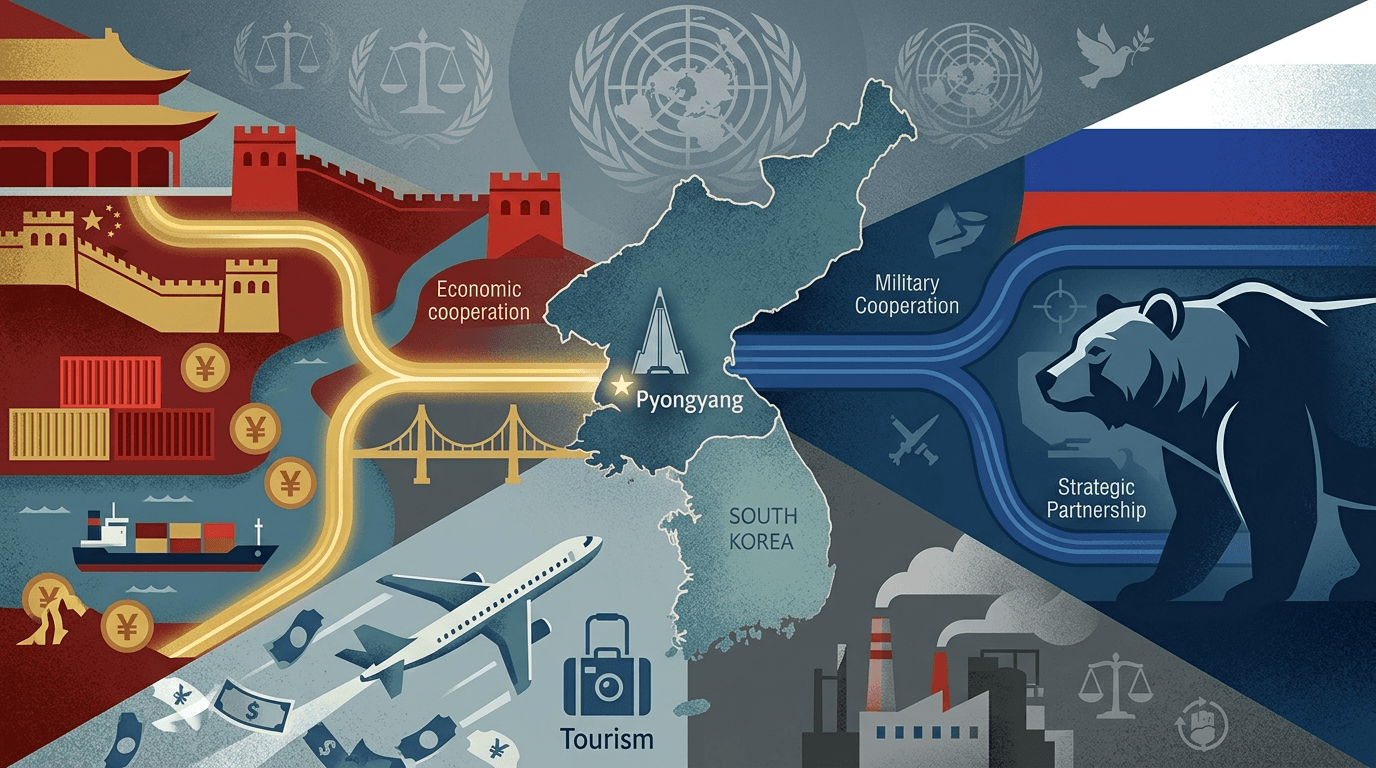
The recent international landscape surrounding North Korea presents a complex picture. While the country seeks economic lifelines through border reopenings, it simultaneously grapples with deepening structural corruption internally and persistent international criticism over human rights abuses. This dual trend offers significant implications for North Korea's survival strategy and the international community's response.
Key Summary: Controlled Opening and Internal Contradictions
North Korea is gradually reopening its borders post-pandemic, expanding economic exchanges primarily with China. Reports from NKNEWS and DAILYNK indicate that visits by Chinese economic delegations and the launch of Beijing-Pyongyang direct flight tourism packages signal a cautious resumption of trade and tourism. This demonstrates the North Korean authorities' determination to secure foreign currency. However, DAILYNK also highlights severe structural corruption, where excessive remittances are demanded from overseas traders, eroding trust between the state and its citizens. Furthermore, CHOSUN and YONHAP report the UN Human Rights Council's 24th consecutive adoption of a resolution on North Korean human rights, underscoring that human rights remain a key international agenda item. Meanwhile, CHOSUN notes the Russian Embassy in Pyongyang's release of a photo of "Putin's lion," symbolically revealing the close ties between North Korea and Russia.
Multi-Angle Comparative Analysis: Economic Necessity and Political Control
North Korea's border reopening is driven by economic necessity, but its implementation is strictly controlled. The preference for air travel over train for tourism packages from Chinese agencies (DAILYNK) illustrates this, likely aimed at minimizing external information inflow and facilitating visitor management. The circulation of North Korean confectionery in Chinese markets, as reported by DAILYNK, suggests limited but ongoing efforts to export products and earn foreign currency.
Despite these outward-looking economic moves, internal structural corruption exposes the fundamental vulnerabilities of the North Korean economy. The forced remittances from overseas traders appear to be a desperate measure to secure funds for regime maintenance, but in the long run, this could stifle economic vitality and escalate public discontent.
Relations with the international community are even more complex. NORTH38 suggests that European engagement with North Korea, amidst high-level diplomatic stagnation, could build sustainable channels through "low politics" cooperation such as forest restoration. This can be seen as an attempt to explore non-political cooperation possibilities given the difficulties in high-level dialogue due to human rights issues (CHOSUN, YONHAP). In contrast, South Korea's initiatives like the opening of the DMZ Peace Road and the resumption of war remains recovery (YONHAP) are unilateral efforts to promote peace, proceeding without direct North Korean response.
Comparison of North Korea's External Engagement Modalities
| Actor/Entity | Engagement Modality | Key Characteristics | Relevant Reports |
|---|---|---|---|
| China | Economic exchange, tourism resumption | Controlled opening, foreign currency acquisition | NKNEWS, DAILYNK |
| Russia | Strategic friendly relations | Symbolic exchanges, display of close ties | CHOSUN |
| Europe | Exploration of 'low politics' cooperation | Non-political, technical exchange potential | NORTH38 |
| International Community | Human rights advocacy | Persistent condemnation, sustained pressure | CHOSUN, YONHAP |
Causal Inference and Background Analysis
North Korea's actions stem from a confluence of factors. First, severe international sanctions and pandemic-induced border closures have significantly impacted the North Korean economy, making foreign currency acquisition a critical task for regime survival. Second, strengthening ties with China and Russia is a strategic choice to mitigate international isolation and potentially serve as a buffer against Western pressure. Third, internal corruption, while leading to inefficient resource allocation and exacerbating citizens' hardships, is likely utilized as a means to secure resources for the ruling elite and maintain regime control.
Future Outlook and Scenarios
North Korea will likely continue to expand limited economic exchanges with China and strengthen its strategic alliance with Russia to overcome international isolation. Tourism resumption will be gradual, but efforts to control external information inflow will persist. Internally, abnormal means of fundraising are likely to continue, which could lead to intensified internal control to suppress public discontent. International pressure on North Korean human rights will remain unwavering, acting as a major impediment to North Korea's integration into the global community.
Implications and Recommendations
North Korea's dual diplomacy and internal contradictions present complex challenges for the international community. Relevant international organizations, NGOs, and government agencies should consider the following:
- UN and International Community: While maintaining international pressure on North Korea's human rights abuses (UN Human Rights Resolution), actively explore possibilities for engagement in "low politics" areas such as humanitarian aid and environmental cooperation. This can improve the lives of North Korean citizens and lay the groundwork for long-term trust-building.
- NGOs and Humanitarian Organizations: As suggested by NORTH38, focus on expanding technical exchanges in non-political areas aligned with North Korea's priorities, such as forest restoration, to build trust and maintain sustainable cooperation channels even in a restricted environment.
- Regional Governments: Closely monitor North Korea's economic reopening with China and its strengthening ties with Russia, enhancing multilateral cooperation to maintain the effectiveness of international sanctions. Simultaneously, analyze the impact of North Korea's internal structural corruption on its citizens' lives and seek ways to improve human rights for North Koreans from a long-term perspective.
North Korea's trajectory is not linear. Limited economic opening for survival, internal control for regime maintenance, and strengthening strategic alliances will intertwine to shape its future. The international community must understand this complexity and continue its efforts for peace and stability on the Korean Peninsula through consistent and flexible approaches.
Comments (0)
Please log in to write a comment.